

No results found
Energy, service and rental costs based on Lithuanian pricing.
A practical guide for manufacturing, logistics, and fleet managers investing in forklift trucks over a five-year lifecycle.
| What's happening? | Fact | What this means for you? |
|---|---|---|
| 3% | Europe is growing the slowest: Global orders increased by 10% in 2025, while the EMEA region grew by only 3%. Meanwhile, Toyota's sales in Europe declined by 5%. | Suppliers need orders, giving buyers stronger negotiating power. |
| 3,70% | Value is growing more slowly than volume. KION reported unit sales up 8.6%, while revenue increased by only 4.9%. Meanwhile, Toyota Material Handling's operating margin declined from 6.0% to 3.7%. | Manufacturers are looking for ways to reduce costs. Make sure your contract clearly specifies what is included in the price, such as service, spare parts, and warranty coverage. |
| Li-ion | Asian manufacturers are increasing their market share in Europe by offering more affordable lithium-ion forklift trucks. | Compare spare parts availability, service network coverage, and the truck's residual value after five years. |
| 2026.04 | Manufacturers have increased prices in response to rising energy and raw material costs. | It may be worth locking in the purchase price early. |
Based on data from Linde trucks delivered by Alwark between 2023 and 2025.
In 2025, more than 45% of electric counterbalance forklift trucks were equipped with lithium-ion batteries, compared with 31% in 2023. Globally, the figure stands at 17.5%.
Lithium-ion batteries can be opportunity charged during work breaks, eliminating the need for battery changes during a shift. They also remove the need for a dedicated charging room and battery watering. In addition, they are more energy-efficient, with lower charging losses than traditional lead-acid batteries.
| Warehouse equipment | Electric counterbalance forklift trucks | Internal combustion counterbalance forklift trucks | |
|---|---|---|---|
| 2023 | 41 % | 45 % | 13 % |
| 2024 | 45 % | 47 % | 8 % |
| 2025 | 63 % | 29 % | 8 % |
Energy and scheduled maintenance costs per operating hour for a 2.5-tonne forklift truck. Prices exclude VAT.
| Li-ion | 0,88 € |
| Lead-acid | 1,06 € |
| SND | 3,76 € |
| Diesel, 2025-09 | 3,65 € |
| Diesel, 2026-09 | 5,56 € |
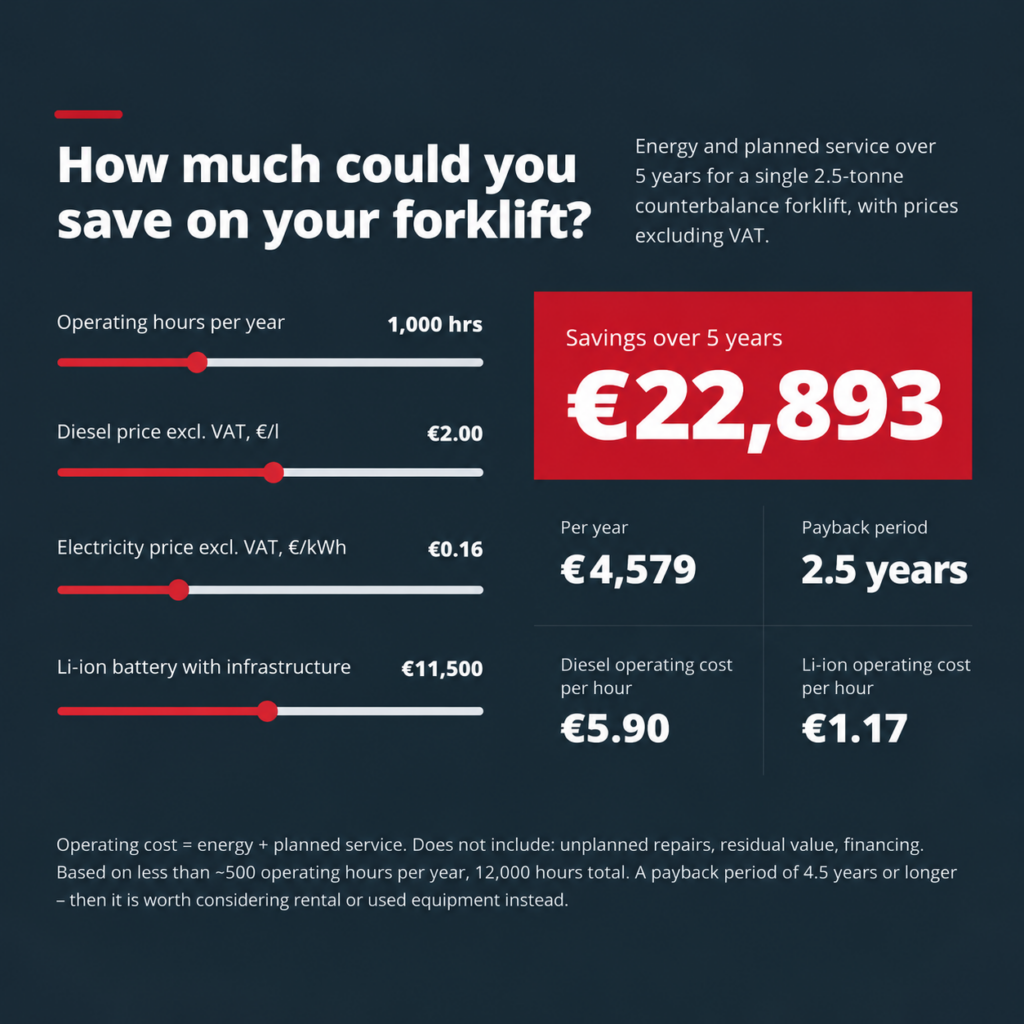
Actual operating costs depend on factors such as electricity tariffs, utilisation rates, and operating conditions.
Start by measuring how many hours your forklift trucks actually operate. Without this data, any return-on-investment calculation is based on assumptions rather than facts.
Estimated savings over five years (€ thousand)
| Operating hours per year | Diesel 2025-09 | Diesel 2026-09 | Electricity +50 % |
|---|---|---|---|
| 800 | 12,9 k€ | 20,6 k€ | 18,8 k€ |
| 1 500 | 24,9 k€ | 39,2 k€ | 35,9 k€ |
| 2 500 | 42,0 k€ | 65,8 k€ | 60,3 k€ |
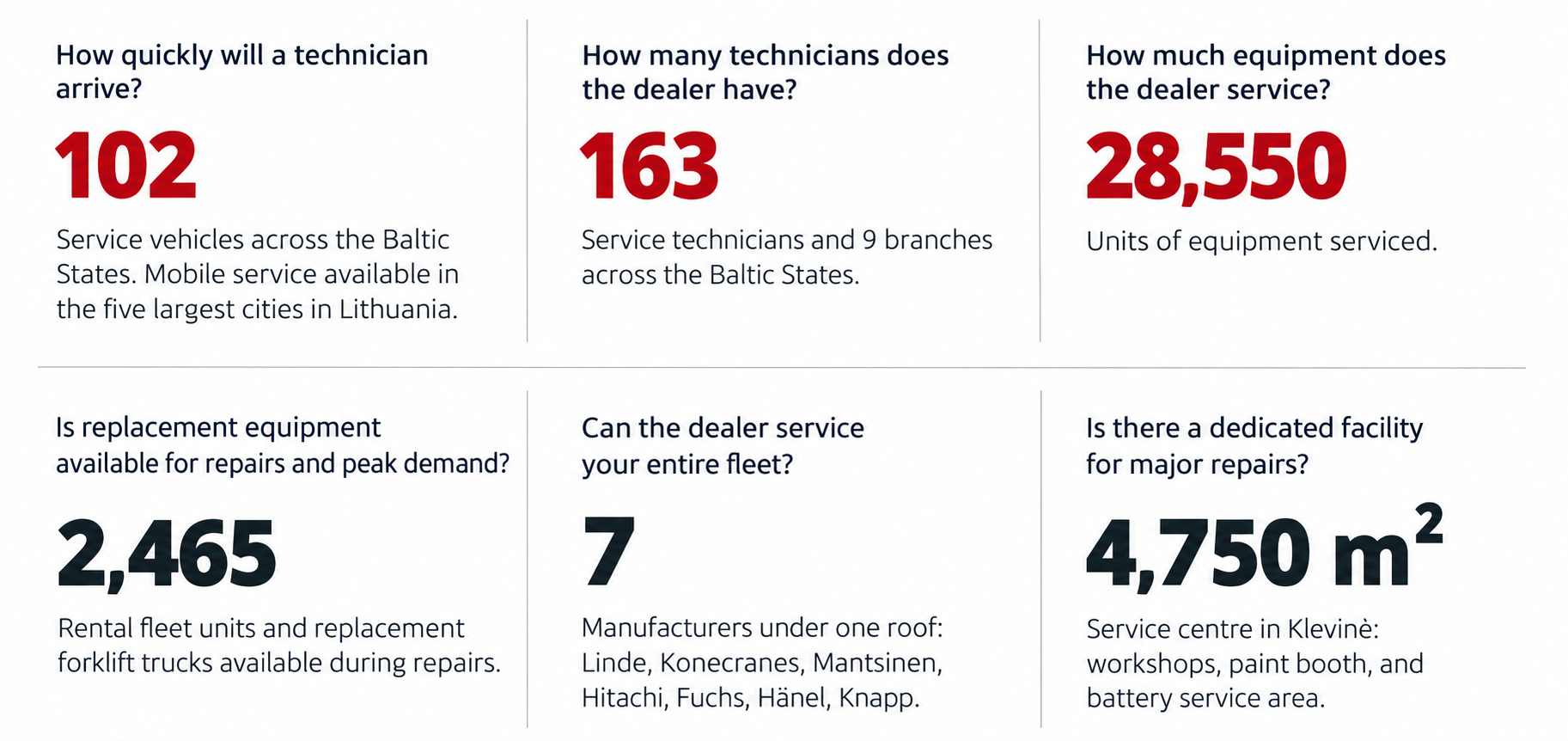
Your forklift truck is serviced by an authorised manufacturer’s dealer. When choosing a forklift, you are also choosing your service partner for the next five years.
A lithium-ion forklift truck operating 1,500 hours per year can save approximately €7,800 annually in energy and scheduled maintenance costs.
Now calculate the cost of a single day of downtime in your operation and compare the two. The duration of downtime largely depends on how quickly the authorised dealer can respond and whether the required spare part is immediately available.
In Lithuania, 50% of Linde equipment is supplied under rental agreements, most commonly through long-term rental contracts.
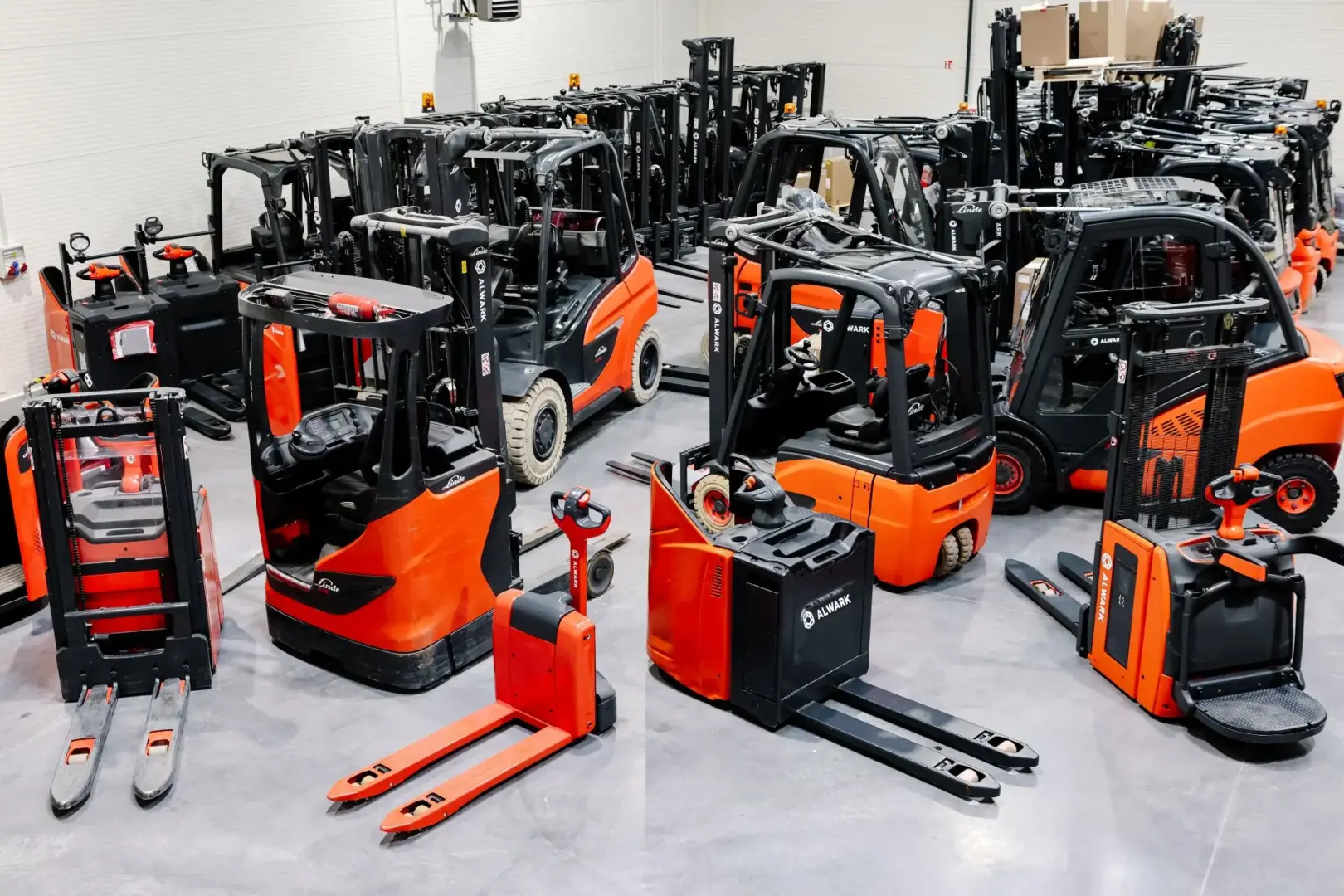
| Situation | Solution |
|---|---|
| The forklift operates up to approximately 500 hours per year. | Long-term rental or a used forklift truck. The additional investment in a lithium-ion battery is unlikely to pay back within 4–5 years. |
| Seasonal peaks and temporary projects | Short-term rental. You only pay for the equipment when you need it. |
| You are considering switching to electric forklifts. | 1–3 month trial rental with telematics. Measure actual operating hours and costs before making an investment. |
| The current forklift is being repaired or you are waiting for a new one to be delivered. | Replacement forklift truck. Keeps your operations running without interruption. |
| Stable operations of 1,500 hours or more | Purchase or lease with a service agreement. Typical payback period: 1–2 years. |
The greatest cost of choosing the wrong forklift is the cost of operational downtime.
| Operating conditions | Solution | Key criterion |
|---|---|---|
| Warehouse, single-shift operation, up to 1,200 operating hours/year | Electric, lead-acid | Lowest initial investment |
| Warehouse, two-shift operation, 2,000–3,500 operating hours/year | Electric, lithium-ion | Opportunity charging during breaks |
| Manufacturing, three-shift, 24/7 operation | Lithium-ion with a charging schedule or internal combustion | Charging window |
| Food and pharmaceutical manufacturing | Only electric | Indoor emissions and hygiene requirements |
| Narrow aisles, high-bay storage | Narrow-aisle or high-lift electric forklift truck | Manoeuvrability and lift height |
| Indoor and outdoor operation, up to 3.5 tonnes | Electric forklift truck with IP protection | Protection against moisture |
| Heavy-duty outdoor operations, over 8 tonnes | Diesel | Duty cycle and operating time |
Equipment prices continue to rise. Manufacturers have increased prices due to higher energy, transport, and raw material costs. If you’re planning to invest, it may be worthwhile securing pricing in advance.
EU Machinery Regulation takes effect. If you make substantial modifications to your equipment—for example, by installing additional components—you may assume certain manufacturer responsibilities. Always consult your authorised dealer before making modifications.
ETS2 will apply to transport and heating fuels. Diesel prices are expected to increase by approximately €0.12/litre (at €45/t CO₂) or up to €0.27/litre (at €100/t CO₂). Any diesel forklift purchased today is likely to operate under these future fuel costs.
| 3 months | 12 months | 24 months |
| Measure your fleet's operating hours, material handling activity, and downtime. Assess the available electrical capacity at your site. Ask your dealer to answer the six key service-related questions. | Categorise your fleet: replace now, replace in the next investment cycle, or retain. Cover peak demand with rental equipment rather than ownership. Implement telematics across at least part of your fleet. | Assess the impact of ETS2 on your diesel fleet. Develop a replacement plan for your internal combustion forklift trucks. Recalculate your fleet's operating costs based on the new pricing. |
Gain a clear picture of your fleet’s performance with actual operating hours and downtime data from telematics. Receive a five-year cost analysis for each forklift truck under three pricing scenarios, along with a tailored recommendation on whether to replace, rent, or retain each truck.